


世界大型企業聯合會最新CEO調查:面對動蕩的商業環境,企業如何維持繁榮發展
Anke Schrader, Charles Mitchell, 世界大型企業聯合會
2022-04-01
中國的CEO們表示,未來,烏克蘭危機和始終無法結束的新冠疫情只會讓他們面臨的許多壓力更加惡化。許多公司和行業的組織結構與經營模式曾經大獲成功,但當前的破壞性因素正在將它們淘汰,對人們的工作方式產生了深遠影響。中國公司也不例外。
 文本設置
文本設置
 Plus(0條)

是什么讓中國CEO們徹夜難眠?
新冠疫情已經進入了第三個年頭,顯然它是一場馬拉松,而不是一次短跑比賽。在中國,疫情的負面后果仍然在持續給中國的經濟和營商環境帶來壓力。
據世界大型企業聯合會(The Conference Board)的年度企業高管前景展望調查顯示,早在烏克蘭危機之前,經濟衰退風險、消費者行為變化、通脹加劇、全球政治動蕩、全球貿易中斷和利潤縮水,是中國CEO們認為2022年影響最大的事件。每一個事件都與疫情的進展直接相關,需要公司緊急采取措施,包括經營模式轉型、現金流管理、成本控制、供應鏈靈活性和旨在打造更有韌性、更靈活的團隊的人力資源管理創新等。這都是中國CEO們認為急需執行的措施。俄烏沖突的影響將加劇中國企業面臨的許多壓力,使公司更迫切地需要采取措施減緩這些事件的影響。
然而,中國和全球的CEO們很少有人相信,面對從新疫情到通脹、氣候變化和供應鏈中斷等未來危機,他們的公司做好了充分準備。

中國人消費模式改變所帶來的挑戰:復雜的變化
新冠疫情改變了中國大多數地區消費者的購物行為,刺激了網絡購物繁榮,給企業帶來了挑戰,迫使它們不得不轉變經營模式,以跟上這種趨勢。事實上,約40%的中國CEO將消費者行為改變列為公司在2022年面臨的具有巨大影響的問題之一,這個比例是在美國和歐洲的CEO的兩倍。但在中國,消費者行為的改變遠比表面看起來更加復雜。
中國政府將電子商務視為未來經濟增長的關鍵引擎,在疫情期間,電商業務繁榮發展,并且一直持續至今。新冠疫情使家庭消費模式從非必需品消費轉變為食物等必需品消費。在疫情之前,城市家庭消費日益傾向于非必需品消費,而必需品消費的增長速度較慢;必需品消費在消費總額中的比例不斷縮小。自疫情爆發以來,非必需品消費的增長速度顯著下降。可支配收入增長放緩、相對疲軟的勞動市場和為控制疫情執行的嚴格出行管制,正在抑制非必需品消費。2021年第4季度,線上零售額同比增長3.9%,遠低于實現中國政府提出的2025年線上零售額增長目標需要達到的7%的年增長率。雖然今年1月和2月的數據令人振奮,但病例數增加和相關商業中斷,將繼續帶來消費下行風險。
從商業的角度,針對消費者行為和態度的變化及其對業務的潛在影響,實時提供數據驅動的洞察極具挑戰性。
導致通脹上升的原因及其持續時間:CEO們的觀點
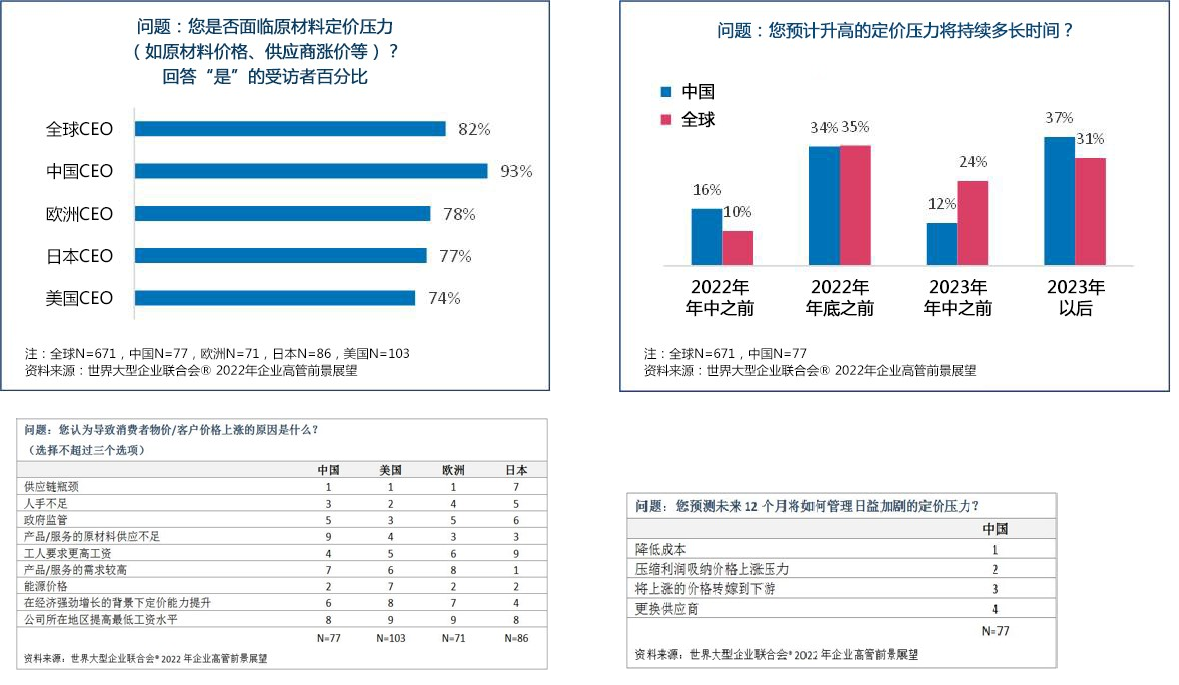
雖然中國公布的通脹率與其他國家相比相對較低,但中國CEO們早在烏克蘭危機爆發之前,就已經在日益擔憂物價和成本上漲問題。超過四分之一的中國CEO將高通脹列為2022年具有重大影響的問題,比去年增加了一倍。約93%的中國CEO們表示,公司的投入,包括原材料和工資,都面臨價格上漲的壓力,并且他們認為這一趨勢在短時間內不會改變。約一半的CEO認為價格上漲壓力將持續到2023年年中甚至更長時間,而這還是他們在烏克蘭危機爆發之前的觀點。他們認為物價上漲的主要原因是供應鏈瓶頸和飆升的能源價格。
CEO們對通貨膨脹的擔憂并非杞人憂天。世界大型企業聯合會預計,中國的消費物價上漲速度目前較低,但未來幾個月將會加速。烏克蘭危機導致全球能源價格上漲,影響了中國玉米、小麥和化肥等農作物的進口。這些因素顯著增加了中國的通脹壓力。中國將很難維持目前確定的2022年3%的整體CPI目標(代表CPI適度上漲)。消費物價上漲以及收入增長放緩、疫情防控限制措施和就業創造速度放慢,將影響2022年的家庭支出增長,并拖累整體經濟增長。有趣的是,相比其他國家的CEO,有更多的中國CEO表示愿意承受價格上漲的壓力。
工作方式將被重新定義:遠程辦公日益普及
中國CEO們表示人力資源面臨的主要挑戰是如何打造一支更有韌性的團隊,建立更具創新力的文化,培養更靈活的團隊。
在疫情停工期間,遠程辦公對許多公司至關重要,這種辦公形式將在全世界繼續存在下去。在中國也不例外,但遠程辦公在中國的普及程度相對較低。全球有三分之一的CEO預測,疫情結束之后,至少40%的員工將遠程辦公,相比疫情之前的17%大幅增加。雖然中國CEO預測員工遠程辦公的比例較低,但他們依舊認為中國的工作方式將發生顯著變化。只有17%的中國CEO表示,計劃在疫情結束一年后,至少40%的員工將遠程辦公(美國的比例為53%)。這比疫情之前的11%有所提高,但遠低于疫情期間的33%。盡管后疫情時代中國遠程辦公的員工絕對數相對較低,但在疫情之前遠程辦公的員工占11%至20%的公司有15%,到疫情之后將增加到33%,增加了超過一倍。公司對遠程辦公的認可,對員工的工作效率有重要影響,并將影響公司的招聘方式、領導模式和如何培養混合工作場所文化。優秀人才們現在可以合理期望自己有機會在喜歡的時間和地點辦公,如果他們的要求被拒絕,就能夠準備跳槽到其他公司。一個被越來越多人接受的現實是,在知識經濟時代,工作應該與地點脫鉤,員工不需要在指定的地點辦公。人們可以在任何地點辦公,在零工經濟中,人們還能夠選擇辦公時間。大多數行業將不再受物理空間的限制。

約42%的中國CEO認為遠程辦公只是權宜之計,從長遠來看難以持續執行,這在全球CEO中比例最高。無論接受短期還是長期混合辦公模式,都將給企業帶來巨大挑戰:超過一半的中國CEO認為,混合辦公模式將增加人才競爭,給傳統人力資源模式帶來更多壓力,而且他們認為這種模式會增加完成項目需要的時間。中國CEO還擔心混合辦公模式會降低員工的工作效率和內部人際關系的質量,削弱企業文化的優勢,降低培養工作技能的效率。積極的一面是:有接近一半的中國CEO預計混合辦公模式會促進創新和外部協作。
落實混合辦公并不容易。超過四分之三的中國CEO表示,高效的混合辦公模式需要大幅修改企業文化,提高內部溝通效率,團隊領導者和企業高管必須學習新的管理技能,還需要重新設計薪酬結構。這都需要企業在執行混合辦公模式時,要有戰略眼光。企業領導者需要明確并果斷決定多少人可以遠程辦公,哪些工作崗位適合遠程辦公,如何管理混合辦公模式,如何確定員工薪酬,以及員工能夠在哪些地點辦公等。
環境、社會與治理問題的重點
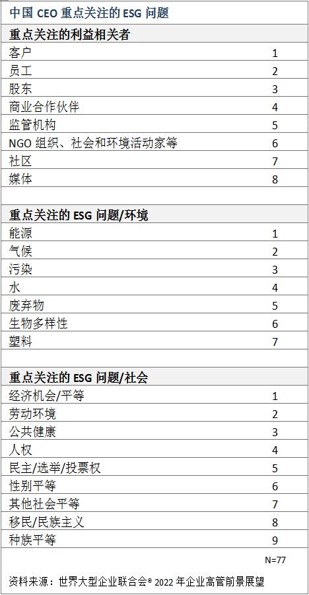
中國CEO們將提高可持續性列為2022年最緊迫的第二大內部問題。為了實現這個目標,企業必須更加重視環境、社會與治理(ESG)問題。我們的調查發現,企業最關注的環境問題是能源和氣候變化,最關注的社會問題是改善經濟發展機會、公平和勞動環境,均符合政府提出的“共同富裕”的目標。
對下一次危機準備不足
我們很難預測明年可能會發生哪些新的危機。但企業通過富有遠見的預測和投資,可以減少風險,并通過超前部署減輕影響,從而避免遭到嚴重破壞。中國和全球的CEO們普遍承認對未來的沖擊準備不足,讓人們對許多企業的韌性產生疑問。許多企業的氣候變化、網絡安全和業務連續性策略尚未成形。
有哪些企業做好了準備?
? 歐洲65%的CEO和美國55%的CEO表示其所在企業做好了應對未來疫情相關危機的充分或非常充分的準備,而中國和日本的CEO的比例分別只有28%和27%。
? 大多數美國和歐洲的CEO(分別為53%和54%)還表示,他們做好了迎接金融動蕩相關危機的妥善準備,而相比之下,中國和日本的CEO的比例分別只有32%和24%。
? 全球不到40%的CEO表示,面對通貨膨脹、網絡安全、自然災害、供應鏈中斷和氣候變化等未來危機可能帶來的各種挑戰,其所在企業已經做好了充分準備。中國CEO的比例更低:
? 通貨膨脹33%
? 網絡安全29%
? 自然災害22%
? 供應鏈中斷29%
? 氣候變化21%
? 社會動蕩19%
? 雖然中國企業相對而言準備不足,但中國CEO們僅將更新危機應急計劃排在2022年內部工作重點的第14位(共24個選項)。
未來的重重挑戰
在中國和全球許多CEO所經營的企業內,包括高管在內的所有人從未經歷過如此嚴重的地緣政治動蕩或通貨膨脹。在這種動蕩的環境下,保持靈活性將是公司繼續繁榮發展的關鍵。在之前的高管挑戰調查中,CEO們認為一家靈活企業的關鍵品質包括:高效敬業的改革領導者;有韌性、能夠適應變化的員工;開放透明、鼓勵暢所欲言的文化;在所有組織層面持續進行透明地溝通;有效利用大數據分析指導決策。如今,企業需要重整旗鼓,并重新構想如何在動蕩不安的全球環境下保持繁榮發展,因此這些品質變得更加重要。問題是CEO和他們的企業能否完成這項任務?(財富中文網)
(編者注:本文基于世界大型企業聯合會2021年10月和11月在全球開展的《企業高管前景展望調查》的結果以及調查報告《2022年企業高管前景展望:重整旗鼓與重新構想》。歡迎登陸www.conference-board.org查看和下載完整報告。世界大型企業聯合會是一家全球性的會員制獨立智庫,致力于在開展公益的同時,對未來發展趨勢提供值得信任的洞察。)
安克·施拉德現任世界大型企業聯合會亞洲研究總監,負責亞洲地區的研究項目。她還負責亞洲可持續性、ESG、公民責任和可持續發展研究與企業參與。安克畢業于德國康斯坦茨大學,取得公共政策與管理碩士學位。
查爾斯·米切爾現任世界大型企業聯合會內容質量執行董事,負責保證該機構研究項目的客觀性、獨立性、準確性和商業相關性。他近幾年在亞太地區投入大量時間,與我們的理事會合作開發針對亞太地區的內容。米切爾曾出版數本探討國際商業文化、風俗習慣和商業禮儀的書籍,取得了美國賓夕法尼亞大學經濟學學士學位。
翻譯:劉進龍
審校:汪皓
是什么讓中國CEO們徹夜難眠?
新冠疫情已經進入了第三個年頭,顯然它是一場馬拉松,而不是一次短跑比賽。在中國,疫情的負面后果仍然在持續給中國的經濟和營商環境帶來壓力。
據世界大型企業聯合會(The Conference Board)的年度企業高管前景展望調查顯示,早在烏克蘭危機之前,經濟衰退風險、消費者行為變化、通脹加劇、全球政治動蕩、全球貿易中斷和利潤縮水,是中國CEO們認為2022年影響最大的事件。每一個事件都與疫情的進展直接相關,需要公司緊急采取措施,包括經營模式轉型、現金流管理、成本控制、供應鏈靈活性和旨在打造更有韌性、更靈活的團隊的人力資源管理創新等。這都是中國CEO們認為急需執行的措施。俄烏沖突的影響將加劇中國企業面臨的許多壓力,使公司更迫切地需要采取措施減緩這些事件的影響。
然而,中國和全球的CEO們很少有人相信,面對從新疫情到通脹、氣候變化和供應鏈中斷等未來危機,他們的公司做好了充分準備。
影響最大的10個外部問題
中國人消費模式改變所帶來的挑戰:復雜的變化
新冠疫情改變了中國大多數地區消費者的購物行為,刺激了網絡購物繁榮,給企業帶來了挑戰,迫使它們不得不轉變經營模式,以跟上這種趨勢。事實上,約40%的中國CEO將消費者行為改變列為公司在2022年面臨的具有巨大影響的問題之一,這個比例是在美國和歐洲的CEO的兩倍。但在中國,消費者行為的改變遠比表面看起來更加復雜。
中國政府將電子商務視為未來經濟增長的關鍵引擎,在疫情期間,電商業務繁榮發展,并且一直持續至今。新冠疫情使家庭消費模式從非必需品消費轉變為食物等必需品消費。在疫情之前,城市家庭消費日益傾向于非必需品消費,而必需品消費的增長速度較慢;必需品消費在消費總額中的比例不斷縮小。自疫情爆發以來,非必需品消費的增長速度顯著下降。可支配收入增長放緩、相對疲軟的勞動市場和為控制疫情執行的嚴格出行管制,正在抑制非必需品消費。2021年第4季度,線上零售額同比增長3.9%,遠低于實現中國政府提出的2025年線上零售額增長目標需要達到的7%的年增長率。雖然今年1月和2月的數據令人振奮,但病例數增加和相關商業中斷,將繼續帶來消費下行風險。
從商業的角度,針對消費者行為和態度的變化及其對業務的潛在影響,實時提供數據驅動的洞察極具挑戰性。
導致通脹上升的原因及其持續時間:CEO們的觀點
雖然中國公布的通脹率與其他國家相比相對較低,但中國CEO們早在烏克蘭危機爆發之前,就已經在日益擔憂物價和成本上漲問題。超過四分之一的中國CEO將高通脹列為2022年具有重大影響的問題,比去年增加了一倍。約93%的中國CEO們表示,公司的投入,包括原材料和工資,都面臨價格上漲的壓力,并且他們認為這一趨勢在短時間內不會改變。約一半的CEO認為價格上漲壓力將持續到2023年年中甚至更長時間,而這還是他們在烏克蘭危機爆發之前的觀點。他們認為物價上漲的主要原因是供應鏈瓶頸和飆升的能源價格。
CEO們對通貨膨脹的擔憂并非杞人憂天。世界大型企業聯合會預計,中國的消費物價上漲速度目前較低,但未來幾個月將會加速。烏克蘭危機導致全球能源價格上漲,影響了中國玉米、小麥和化肥等農作物的進口。這些因素顯著增加了中國的通脹壓力。中國將很難維持目前確定的2022年3%的整體CPI目標(代表CPI適度上漲)。消費物價上漲以及收入增長放緩、疫情防控限制措施和就業創造速度放慢,將影響2022年的家庭支出增長,并拖累整體經濟增長。有趣的是,相比其他國家的CEO,有更多的中國CEO表示愿意承受價格上漲的壓力。
通脹示意圖
工作方式將被重新定義:遠程辦公日益普及
中國CEO們表示人力資源面臨的主要挑戰是如何打造一支更有韌性的團隊,建立更具創新力的文化,培養更靈活的團隊。
在疫情停工期間,遠程辦公對許多公司至關重要,這種辦公形式將在全世界繼續存在下去。在中國也不例外,但遠程辦公在中國的普及程度相對較低。全球有三分之一的CEO預測,疫情結束之后,至少40%的員工將遠程辦公,相比疫情之前的17%大幅增加。雖然中國CEO預測員工遠程辦公的比例較低,但他們依舊認為中國的工作方式將發生顯著變化。只有17%的中國CEO表示,計劃在疫情結束一年后,至少40%的員工將遠程辦公(美國的比例為53%)。這比疫情之前的11%有所提高,但遠低于疫情期間的33%。盡管后疫情時代中國遠程辦公的員工絕對數相對較低,但在疫情之前遠程辦公的員工占11%至20%的公司有15%,到疫情之后將增加到33%,增加了超過一倍。公司對遠程辦公的認可,對員工的工作效率有重要影響,并將影響公司的招聘方式、領導模式和如何培養混合工作場所文化。優秀人才們現在可以合理期望自己有機會在喜歡的時間和地點辦公,如果他們的要求被拒絕,就能夠準備跳槽到其他公司。一個被越來越多人接受的現實是,在知識經濟時代,工作應該與地點脫鉤,員工不需要在指定的地點辦公。人們可以在任何地點辦公,在零工經濟中,人們還能夠選擇辦公時間。大多數行業將不再受物理空間的限制。
中國疫情之前/期間/之后的遠程辦公百分比
約42%的中國CEO認為遠程辦公只是權宜之計,從長遠來看難以持續執行,這在全球CEO中比例最高。無論接受短期還是長期混合辦公模式,都將給企業帶來巨大挑戰:超過一半的中國CEO認為,混合辦公模式將增加人才競爭,給傳統人力資源模式帶來更多壓力,而且他們認為這種模式會增加完成項目需要的時間。中國CEO還擔心混合辦公模式會降低員工的工作效率和內部人際關系的質量,削弱企業文化的優勢,降低培養工作技能的效率。積極的一面是:有接近一半的中國CEO預計混合辦公模式會促進創新和外部協作。
落實混合辦公并不容易。超過四分之三的中國CEO表示,高效的混合辦公模式需要大幅修改企業文化,提高內部溝通效率,團隊領導者和企業高管必須學習新的管理技能,還需要重新設計薪酬結構。這都需要企業在執行混合辦公模式時,要有戰略眼光。企業領導者需要明確并果斷決定多少人可以遠程辦公,哪些工作崗位適合遠程辦公,如何管理混合辦公模式,如何確定員工薪酬,以及員工能夠在哪些地點辦公等。
環境、社會與治理問題的重點
中國CEO們將提高可持續性列為2022年最緊迫的第二大內部問題。為了實現這個目標,企業必須更加重視環境、社會與治理(ESG)問題。我們的調查發現,企業最關注的環境問題是能源和氣候變化,最關注的社會問題是改善經濟發展機會、公平和勞動環境,均符合政府提出的“共同富裕”的目標。
ESG重點問題列表
對下一次危機準備不足
我們很難預測明年可能會發生哪些新的危機。但企業通過富有遠見的預測和投資,可以減少風險,并通過超前部署減輕影響,從而避免遭到嚴重破壞。中國和全球的CEO們普遍承認對未來的沖擊準備不足,讓人們對許多企業的韌性產生疑問。許多企業的氣候變化、網絡安全和業務連續性策略尚未成形。
有哪些企業做好了準備?
? 歐洲65%的CEO和美國55%的CEO表示其所在企業做好了應對未來疫情相關危機的充分或非常充分的準備,而中國和日本的CEO的比例分別只有28%和27%。
? 大多數美國和歐洲的CEO(分別為53%和54%)還表示,他們做好了迎接金融動蕩相關危機的妥善準備,而相比之下,中國和日本的CEO的比例分別只有32%和24%。
? 全球不到40%的CEO表示,面對通貨膨脹、網絡安全、自然災害、供應鏈中斷和氣候變化等未來危機可能帶來的各種挑戰,其所在企業已經做好了充分準備。中國CEO的比例更低:
? 通貨膨脹33%
? 網絡安全29%
? 自然災害22%
? 供應鏈中斷29%
? 氣候變化21%
? 社會動蕩19%
? 雖然中國企業相對而言準備不足,但中國CEO們僅將更新危機應急計劃排在2022年內部工作重點的第14位(共24個選項)。
未來的重重挑戰
在中國和全球許多CEO所經營的企業內,包括高管在內的所有人從未經歷過如此嚴重的地緣政治動蕩或通貨膨脹。在這種動蕩的環境下,保持靈活性將是公司繼續繁榮發展的關鍵。在之前的高管挑戰調查中,CEO們認為一家靈活企業的關鍵品質包括:高效敬業的改革領導者;有韌性、能夠適應變化的員工;開放透明、鼓勵暢所欲言的文化;在所有組織層面持續進行透明地溝通;有效利用大數據分析指導決策。如今,企業需要重整旗鼓,并重新構想如何在動蕩不安的全球環境下保持繁榮發展,因此這些品質變得更加重要。問題是CEO和他們的企業能否完成這項任務?(財富中文網)
(編者注:本文基于世界大型企業聯合會2021年10月和11月在全球開展的《企業高管前景展望調查》的結果以及調查報告《2022年企業高管前景展望:重整旗鼓與重新構想》。歡迎登陸www.conference-board.org查看和下載完整報告。世界大型企業聯合會是一家全球性的會員制獨立智庫,致力于在開展公益的同時,對未來發展趨勢提供值得信任的洞察。)
安克·施拉德現任世界大型企業聯合會亞洲研究總監,負責亞洲地區的研究項目。她還負責亞洲可持續性、ESG、公民責任和可持續發展研究與企業參與。安克畢業于德國康斯坦茨大學,取得公共政策與管理碩士學位。
查爾斯·米切爾現任世界大型企業聯合會內容質量執行董事,負責保證該機構研究項目的客觀性、獨立性、準確性和商業相關性。他近幾年在亞太地區投入大量時間,與我們的理事會合作開發針對亞太地區的內容。米切爾曾出版數本探討國際商業文化、風俗習慣和商業禮儀的書籍,取得了美國賓夕法尼亞大學經濟學學士學位。
翻譯:劉進龍
審校:汪皓
What Is Keeping CEOs in China Up at Night?
Now in its third year, the COVID-19 pandemic is clearly a marathon, not a sprint. In China, the negative consequences of the pandemic continue to exert pressure on the Chinese economy and business environment.
Even before the Ukraine crisis, recession risk, changing consumer behaviors, rising inflation, global political instability, global trade disruptions, and margin compression were at the top of high-impact events in 2022 for CEOs in China according to The Conference Board’s annual C-Suite Outlook survey. Each is directly tied to the pandemic’s course and requires urgent action across business model transformation, cash flow management, cost containment, supply chain flexibility, and innovative human capital management aimed at building a more resilient and agile workforce. All of these are priority actions on the radar of CEOs in China. The fallout from the situation in Ukraine will make many of these stress points more intense and the actions to mitigate their impact more urgent.
However, few CEOs globally and in China believe their organizations are well prepared to deal with future crises from new pandemics to inflation to climate change and supply chain disruption.
The Challenge of Changing Chinese Consumption Patterns: A Complex Story
As in most places, the COVID pandemic has shifted Chinese consumer buying behaviors, producing a boom in online sales and challenging firms to modify their business models to keep up. Indeed, almost 40% of CEOs in China cite changes in consumer behavior as a significant high impact issue for their organizations in 2022 — double the number of CEOs in the US and Europe. But in China, the story of consumer behavior is more complex than it appears on the surface.
E-commerce, which the government considers to be a key engine of future growth, has boomed throughout the pandemic period in China — until recently. The COVID pandemic has shifted previous household spending patterns away from discretionary spending towards non-discretionary necessities like food. Before the pandemic, urban households were allocating a growing share of their spending to discretionary categories while spending on necessities grew at a much slower pace; its share in total consumption shrinking. Since the start of the pandemic, growth rates for discretionary spending categories have slowed down significantly. Slower disposable income growth, a relatively weak labor market, and strict mobility controls for COVID containment are holding back discretionary spending. Q4 2021 online retail sales growth was 3.9 percent year-over-year, substantially below the 7 percent annual growth needed to hit the government’s official 2025 online retail sales growth targets. January and February data surprised to the upside, but rising COVID cases and associated commercial disruptions will continue to pose downside risks for consumption.
From a business perspective, providing real-time data-driven insights on changing consumer behaviors and attitudes and their potential impact on the business is a critical challenge.
What’s Driving Inflation and How Long Will It Last: the CEO View
While reported inflation rates in China are relatively low compared to the rest of the world, there was growing concern among CEOs in China about rising prices and costs even before the Ukraine crisis. More than a quarter of China CEOs cite rising inflation as a high impact issue in our 2022 survey—more than double the percentage from just a year earlier. Some 93% of CEOs in China say they are facing upward pricing pressures for inputs, including raw materials and wages — and it’s not going away anytime soon in their view. Almost half believe this pressure will persist until mid-2023 and beyond—and that was before the Ukraine crisis. They see the main drivers as supply chain bottle necks and soaring energy prices.
CEO concerns about inflation are justified. The Conference Board expects the currently low inflation in consumer prices in China to climb in the coming months. The Ukraine crisis is causing a rise in global energy prices and disruptions to China’s imports of agricultural products such as corn, wheat, and fertilizer. All add significantly to inflationary pressure. The current headline CPI target of 3% (implying modest CPI growth) in 2022 will be challenging to maintain. Rising consumer price inflation, combined with slow income growth, COVID restrictions, and slow job creation, will weigh on household expenditure growth in 2022 and drag on growth. Interestingly, more CEOs in China say they are willing to absorb price increases than their colleagues globally.
How Work Will Get Redefined: Remote Work Expected to Grow
CEOs in China say that the main human resource challenges ahead are building a more resilient workforce, establishing a more innovative culture, and developing more agile teams.
Remote work, vital to many firms during pandemic-related shutdowns, is here to stay globally. So too for China, but to a lesser extent. A third of CEOs globally expect that at least 40% of employees will work remotely after the pandemic subsides compared to 17% prepandemic. While the percentages in China are smaller, they still signal a significant change within the local context. In China, just 17% of CEOs say they are planning for at least 40% of employees to be remote one year after the pandemic subsides (compared to 53% in the US). That number is up from just 11% pre-pandemic in China, but down from 33% during the pandemic. Despite a relatively low absolute number of remote employees in a post-pandemic China, the firms that had between 11% and 20% of employees working remotely before the pandemic will more than double from 15% to 33% post pandemic. This newfound embrace of remote work carries important implications for worker productivity and how organizations hire, lead, and foster a hybrid workplace culture. Talented people can now reasonably expect opportunities to work when and where they like—and may be prepared to seek employment elsewhere if these choices are denied to them. The growing reality is that, in the knowledge economy, work has been decoupled from location and employees no longer must be in a specific place to do a job. Talent can work from anywhere, and in the gig economy at any time. Physical space is no longer a constraint for most industries.
Some 42% of CEOs in China see remote work only as a temporary fix that is unsustainable in the long run— by the far the highest percentage of CEOs with this view globally. Embracing a hybrid work mode, either in the short-term or for the long haul presents significant challenges: more than half of China CEOs believe a hybrid model will increase the competition for talent putting added pressure on traditional HR practices and they believe projects will take longer to complete. Collectively, they fear that it will also decrease worker productivity, the quality of internal relationships, the strength of corporate culture, and the pace of skill building. On the positive side: just under half expect to see improvements in innovation and external collaboration.
Getting it right will take work. More than three-quarters of China CEOs say a high performing hybrid work model requires significant change in corporate culture, more effective internal communication, new management skills for team leaders and executives, and a rethink of total rewards structures. All of this requires a strategic approach to implementing hybrid work models. Business leaders need to be clear and decisive about how much remote work will be allowed and in what types of jobs, how hybrid work models will be managed, how workers will be compensated, and where workers can be located.
A Look at ESG Priorities
CEOs in China cite becoming more sustainable as their second highest internal priority for 2022. Achieving this will require greater focus on environmental, social, and governance (ESG) issues. According to our survey their top environmental priorities are energy and climate change, and their top social issues are improving economic opportunity, equality and labor conditions – all in line with the government’s “Common Prosperity” campaign.
Shocking Lack of Preparedness for the Next Crisis
What new crises may emerge in the coming year is impossible to predict. But with some foresight and investment, crippling disruptions can be prevented by reducing risk exposures and taking preemptive measures to mitigate their impacts. The generally admitted lack of preparedness for future shocks among CEOs both in China and globally raises questions about the resilience of many organizations. For many, climate change, cyber security and business continuity strategies remain formative.
Who is ready for what?
? A total of 65% of CEOs in Europe and 55% in the U.S. say their organizations are well or very well prepared to handle a future pandemic-related crisis, compared to just 28% in China and 27% in Japan.
? A majority of US and European CEOs (53% and 54% respectively) also say they are well prepared to meet a crisis related to financial instability compared to just 32% in China and 24% in Japan.
? Globally less than 40% of CEOs say their organizations are well prepared to meet challenges posed by future crisis related to inflation, cybersecurity, natural disasters, supply chain disruptions, and climate change. The numbers are worse for China:
? inflation 33%
? cybersecurity 29%
? natural disasters 22%
? supply chain disruptions 29%
? climate change 21%
? civil unrest 19%
? Despite this relative lack of preparedness, update crises contingency plans ranks just 14th (out of 24 choices) as an internal focus for CEOs in China in 2022.
So Many Challenges Ahead
Many CEOs in China and globally are running organizations where their workforce, including key C-suite executives, have never experienced such elevated levels of geopolitical instability or such inflationary conditions. Agility will be a critical factor to thrive in such a turbulent environment. In our previous C-Suite Challenge surveys, CEOs identified the critical traits that make an agile organization as: effective and engaged change leaders; resilient employees/individuals that adapt to change; an open and transparent speak-up culture; communicating consistently and transparently at all organizational level and effective use of big data analytics to inform decision making. All of these traits are now more essential than ever as organizations reset and reimagine to thrive in the unquietly turbulent global environment ahead. The question is: are CEOs and their organizations up to the task?
(Editor’s Note: This article is based on the findings of The Conference Board C-Suite Outlook Survey which was fielded globally in October and November of 2021 and reported in “C-Suite Outlook 2022: Reset and Reimagine”. Please visit www.conference-board.org to learn more and to download the full report. The Conference Board is a global, independent member-driven think tank that delivers trusted insights for what’s ahead while working in the public interest.
Anke Schrader, Research Director, The Conference Board Asia, oversees research programs for the Asia region. She also leads research and corporate engagement on sustainability, ESG, citizenship, and sustainable development for Asia. Anke graduated from the University of Konstanz, Germany with a master’s degree in Public Policy and Management.
Charles Mitchell, the Executive Director, Content Quality at The Conference Board, is responsible for ensuring the objectivity, independence, accuracy, and business relevance of the organization’s research. In recent years he has spent considerable time in Asia-Pacific, working with our Councils to develop region-specific content. He is the author of several books dealing with international business cultures, customs, and etiquette and holds a bachelor’s degree in economics from the University of Pennsylvania in the US.

請打開財富Plus APP